Materials and safety
Glass has four ways of going wrong: what it touches, how hot it gets, what burns near it and how it breaks. Each one is set out here, and each one appears again on the product it applies to.
Last updated 13 August 2026
Food contact — EU 1935/2004
Glass intended to hold food or drink is a food contact material and falls under Regulation (EC) 1935/2004. Every piece in this shop that is intended for food contact carries a declaration of conformity with a reference published on its own page. You can request the declaration itself at any time from support@studioabout.shop by quoting that reference.
Not every piece is intended for food contact. Vases, candle holders, suncatchers, coasters, trinket dishes, paperweights and napkin weights are decorative only. That is stated on the product card, on the product page and in your bag, and it cannot be dismissed.
Lead
Everything in this shop is lead-free. We do not sell lead crystal at all.
This matters more than it sounds. Traditional lead crystal — the material decanters and fine stemware have historically been made from — contains lead oxide, which can migrate into the contents, and the risk rises with acidic drinks and with long storage. Rather than publish a set of use restrictions for it, we do not stock it. The Wine Decanter in this range is soda-lime glass in smoke, not crystal.
The rim of anything you drink from
On a drinking glass, the 20 mm below the lip is the part that touches your mouth. On every drinking glass here that band is bare, uncoated glass — no coating, no paint, no transfer, no gilding.
This is enforced in the code that builds this site: a drinking glass recorded as having a coated rim cannot be published. It fails the build rather than reaching a product page.
Temperature
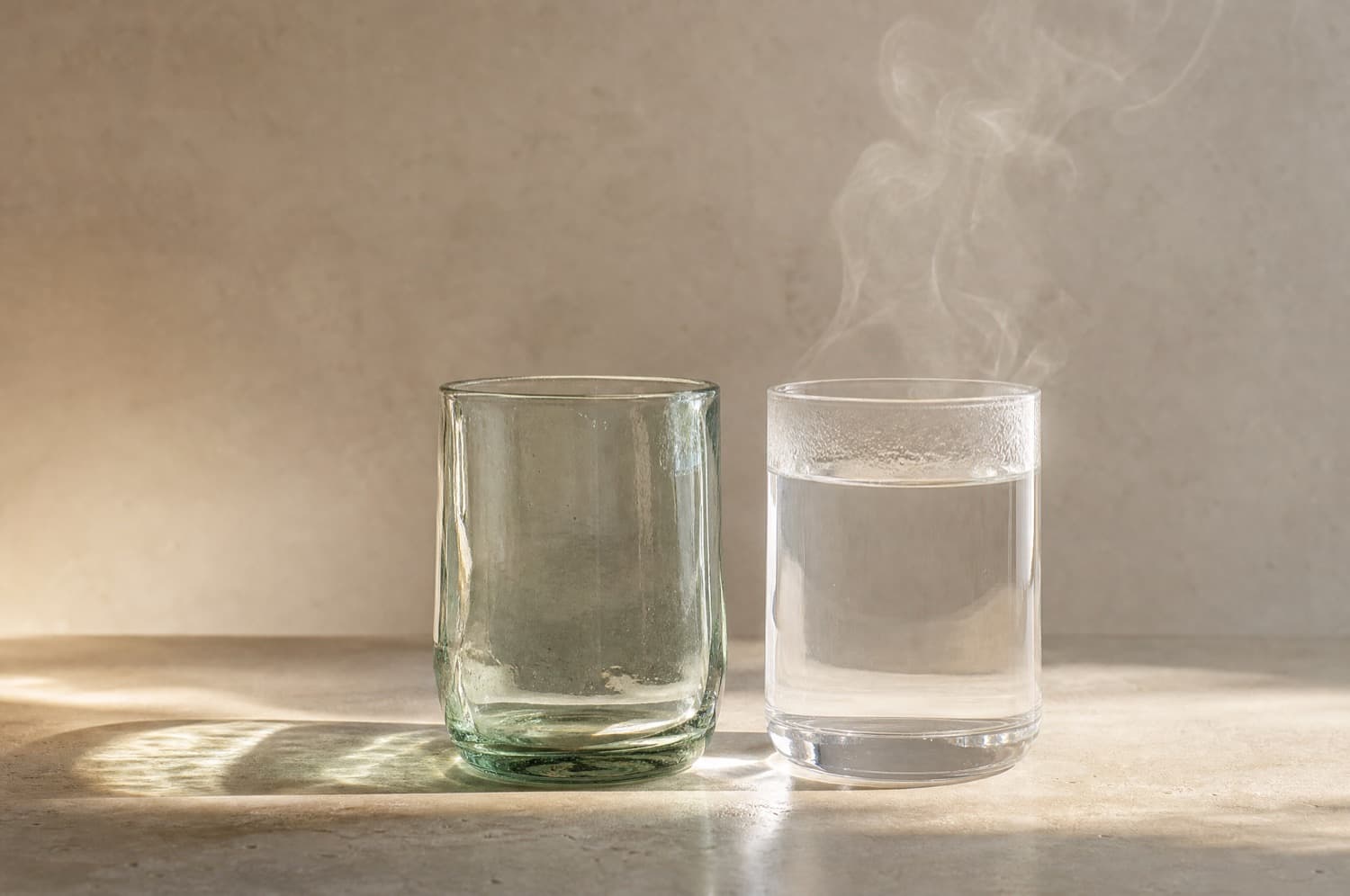
Two glass types are used in this range, and the difference between them decides what you can safely put in a piece.
- Soda-lime. Ordinary glass. It tolerates a temperature change of roughly 30 °C, and the pieces here are rated to a contents temperature of 70 °C. Do not pour boiling water into soda-lime glass, and do not move it straight between hot and cold — from a hot wash onto a cold worktop, for example. Thermal shock is the most common way these break.
- Borosilicate. Tolerates a temperature change of roughly 120 °C and is rated here to a contents temperature of 150 °C. This is the glass used for the coffee and tea glasses and for the deep dish, and it is why those are suitable for hot drinks where the soda-lime pieces are not.
Each product states its own figures. We do not describe any piece as heat-resistant glass in general terms, and only the Deep Dish Ø20 is intended for an oven, to 180 °C. Nothing in this range is for a hob, a grill, a direct flame or a microwave.
Candles and open flame
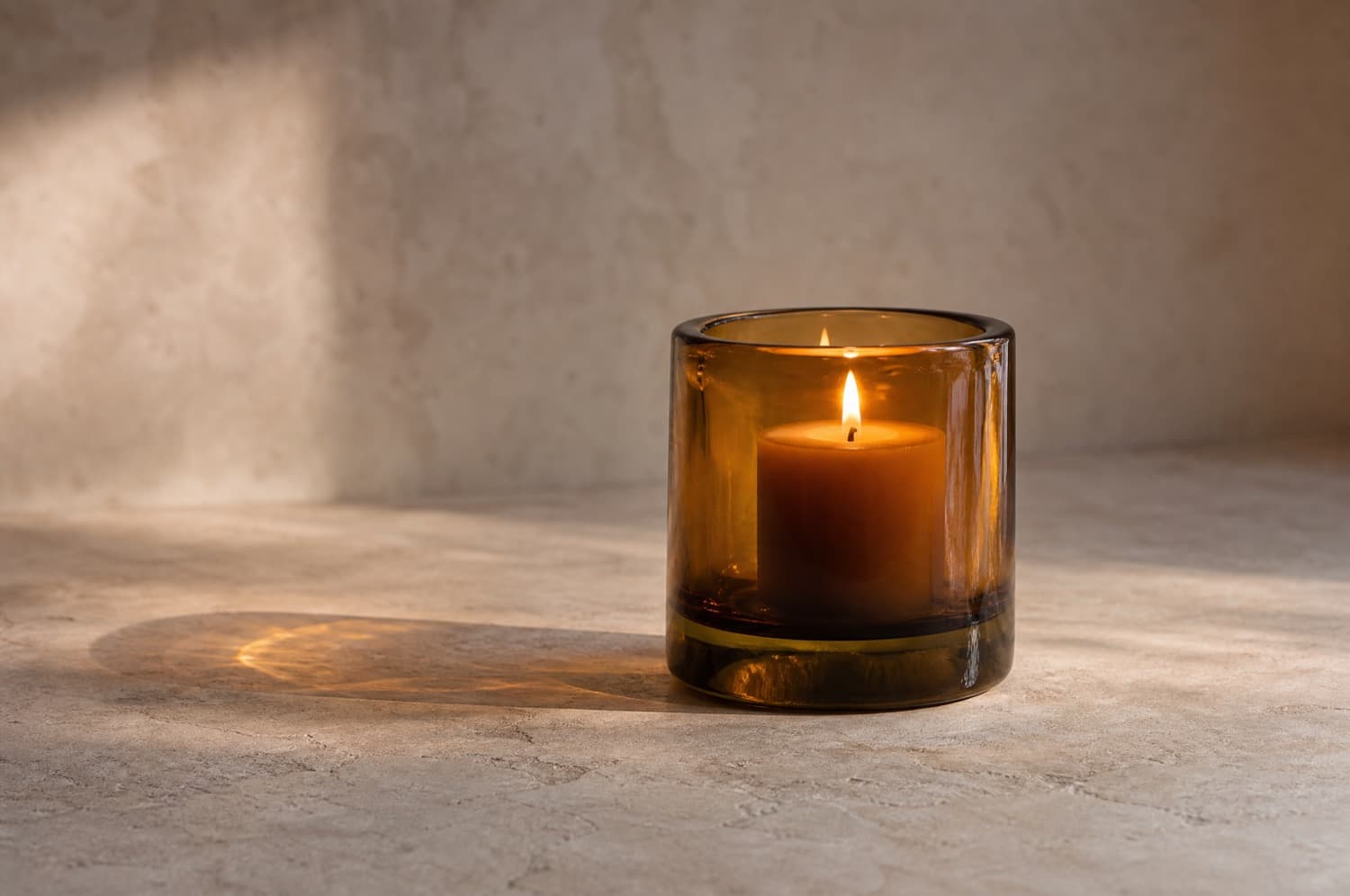
Every candle holder in this range states the candle diameter it is made for. Using a wider candle wedges it in the well and can crack the glass as the wax warms and expands.
- Never leave a burning candle unattended.
- Glass expands when it is heated and can crack. Do not relight a holder that is still hot, and never move a holder with a lit candle in it.
- Do not burn a candle down below about 20 mm of remaining wax. A flame at the base concentrates heat on one part of the glass.
- Keep the flame clear of curtains, paper and anything else that will catch, and keep holders out of reach of children and animals.
- Let a holder cool completely before washing it.
Solid glass — the prism, the paperweight and the napkin weights — focuses sunlight. Do not leave those where the light they project falls on paper or dry fabric for long periods.
Breakage
Glass breaks, and broken glass cuts. None of the pieces here is toughened, and we make no claim that any of them survives a drop.
- Stop using a piece that has chipped or cracked. A chipped rim is a cutting edge, and a crack will run under thermal or mechanical stress.
- If a piece breaks, pick up the large pieces with a stiff brush and dustpan rather than your hands, then go over the area with a damp cloth or damp kitchen paper to lift the splinters you cannot see.
- Wrap the pieces in thick paper or card before putting them in the bin, so nobody handling the bag is cut.
- If glass breaks in the sink, empty the water before reaching in.
- For a cut, wash it, check that no glass is left in the wound, and get medical attention for anything deep or that will not stop bleeding.
If a piece arrives broken, that is a delivery matter and we replace or refund it — see delivery and damage.
Mouth-blown pieces and tolerances
Pieces described as mouth-blown are genuinely mouth-blown. In those pieces expect a wall that varies in thickness, a rim that is not perfectly level, small trapped air bubbles and a body that is not exactly symmetrical. These are characteristics of the process and are not faults. Stated dimensions and capacities for mouth-blown pieces vary within 5%.
Machine-formed pieces are described as machine-formed. We do not describe anything as mouth-blown that is not.
Where things are designed and made
Every product states designed in and made in as two separate facts. The design work happens in Aarhus. The glass itself is made by glassworks in Poland, Czechia, Portugal and Slovakia, named per piece.
We do not describe this range as Danish-manufactured, because it is not.
Everyday care
- Where a piece is marked dishwasher safe, load it so it cannot knock against anything else. Most domestic breakage happens in the rack, not in use.
- Hand wash the pieces marked hand wash — narrow necks, irregular bodies and wide flat bases do not sit reliably in a rack.
- Do not use abrasive pads or scouring powder on any of it, and particularly not on surface-coated pieces.
- Cloudiness that builds up over time is usually limescale or detergent film. Warm water and a little white vinegar clears it.
Questions about anything on this page: write to support@studioabout.shop or call +45 29471635. Monday to Friday, 09:00–16:00 CET.