Colour and light
Coloured glass is the category where things most often look different at home than they did on a screen. This page explains why, what we do about it, and where the limits of our photographs are.
Last updated 13 August 2026
Where the colour is
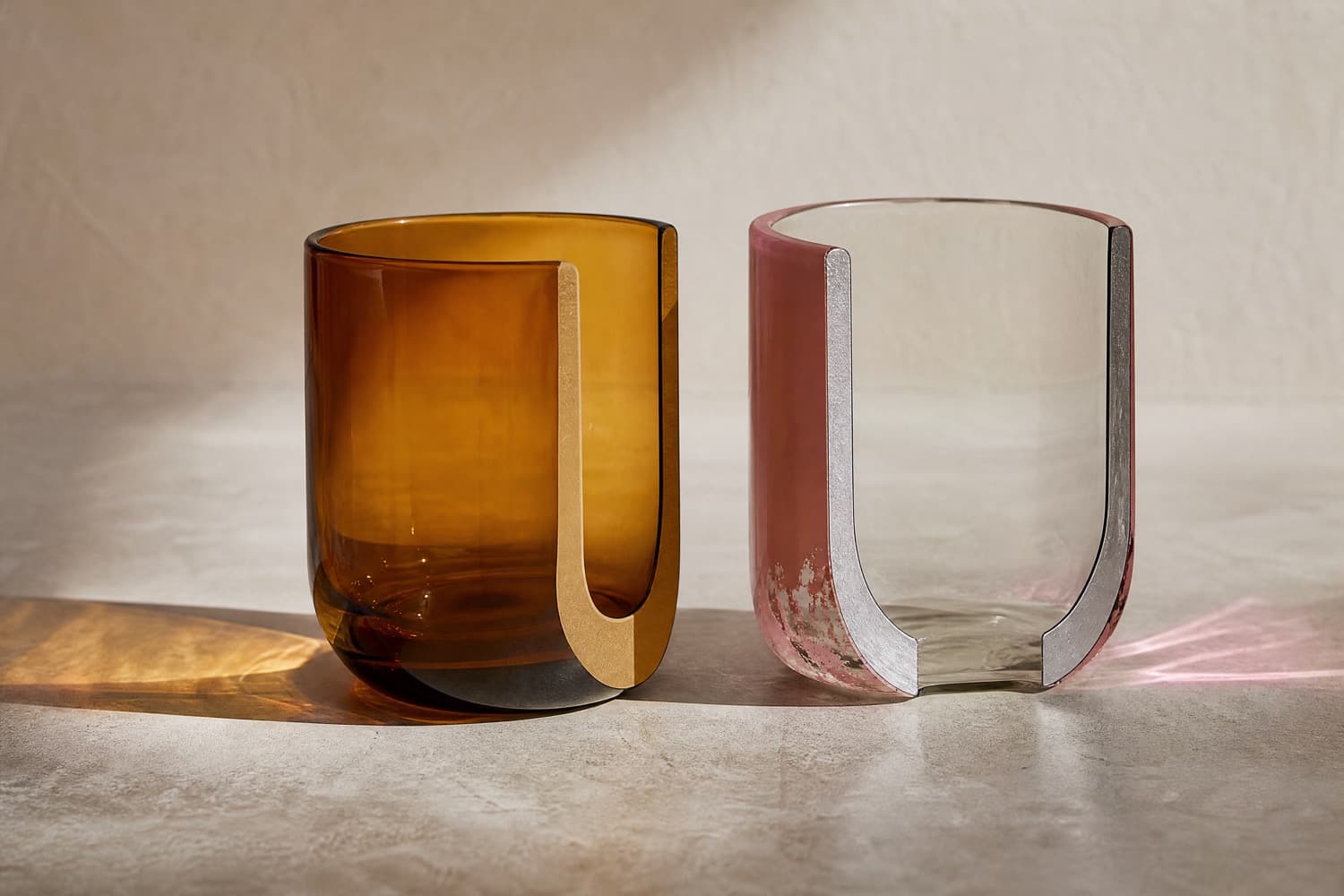
Glass can be coloured in three ways, and they do not behave alike over time. Every product page states which one applies.
As things stand, every piece in this range is through-coloured. The other two are described here anyway, for two reasons: so you know what the distinction is when you meet it elsewhere, and because if we ever do stock a coated or painted piece it will be labelled as one and carry the wear warning below.
- Through-coloured. The colouring agent is in the glass itself, mixed into the batch before the piece is formed. The colour is the material. Handling, washing and abrasion cannot remove it, because there is no layer to remove. Most of this range is through-coloured.
- Surface-coated. Clear or lightly tinted glass with a coloured coating applied to the outside. Repeated dishwashing and daily handling wear that coating. It thins, it can become patchy, and it typically shows first at the base and wherever the piece is gripped.
- Hand-painted. Decoration applied by hand. The least durable of the three. We make no claim about how long a painted decoration survives in a dishwasher.
What we do not claim
Two statements you will not find anywhere on this site, because neither is true of the goods we sell:
- That any piece is “colour-fast forever”. Through-coloured glass keeps its colour because the colour is the material, but that is a description of how it was made, not a guarantee against every possible future condition.
- That the colour “never fades”. For surface-coated and hand-painted pieces this would be plainly false — those finishes do wear — and we say so on the pieces it applies to rather than hoping it goes unnoticed.
Why the same glass looks like a different colour
Coloured glass does not have a fixed appearance. What you see is the light in the room after it has been through the glass, so changing the light changes the colour. Four things move it:
- The colour temperature of the light. The same amber glass reads cool and slightly grey under north daylight and deep orange under a 2200 K lamp.
- Where the light is relative to you. Backlit, glass transmits and glows. Front-lit, it mostly reflects and reads much darker.
- The thickness of the glass at that point. Colour accumulates through the material, so a thick base is always deeper than a thin wall, and a solid piece is deeper again.
- What is inside it. Water lightens; tea, wine, milk and juice each combine with the glass into a colour that is neither one nor the other.
How the four references were photographed
For the pieces where all four exist, we photograph the same object four times, once under each condition below. The object, the camera position, the distance and the framing are held constant; only the light changes.
- Daylight. North-facing window, no direct sun, about 5600 K.
- Warm indoor. Domestic tungsten lighting, about 2700 K.
- Evening lamp. One small table lamp at night, about 2200 K.
- Backlit by window. Bright window directly behind the object.
Held constant across all four:
- Camera 60 cm from the object, lens at object height.
- Off-white plaster, pale oak surface.
- White balance set to the light in use. No colour grading applied.
We do not filter one photograph to fake the other three. A colour filter applied to a single frame would produce a colour the glass does not actually have under that light, which is exactly the misrepresentation this feature exists to prevent. Where a piece is missing any of the four frames, it does not appear in Colour Preview at all rather than appearing with a simulated one.
The limit of any photograph
Screens do not show glass accurately, and no photograph on this site is a colour match. Your display, its brightness and its colour profile all change what you see, and the light in your own room is different again from the light these were taken in. Treat the four references as a guide to how much a colour moves between conditions, not as a promise of what will arrive.
If the colour is not what you expected, that is a legitimate reason to use your 14-day right of withdrawal — you do not have to give a reason at all, and “the colour was not right” is as good as any.
If you would rather not guess, describe your room to us on the colour advice form and we will tell you which colours hold up in it.
Mouth-blown pieces
Pieces described as mouth-blown are genuinely mouth-blown, and that term is used only where it is true. In those pieces the wall thickness varies as it goes round, which means the colour is uneven by nature — deeper where the glass is thicker. Bubbles, a rim that is not perfectly level and dimensions that vary within 5% are characteristics of the process, not faults.
Questions about anything on this page: write to support@studioabout.shop or call +45 29471635. Monday to Friday, 09:00–16:00 CET.